
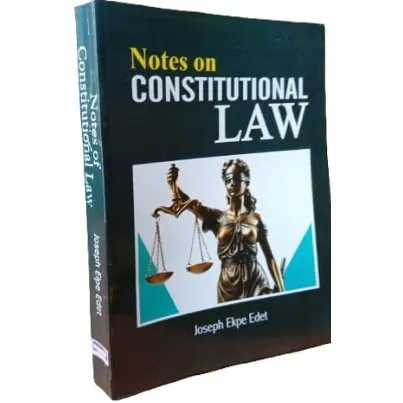


Description
The Constitution, known as the grundnorm by Kelsen, referred to as the alpha and omega, the fons et origo by Niki Tobi, and the birth certificate of any nation by Mike Ozekhome is one document every Nigerian ought to have. It protects the rights of individuals and helps maintain the balance of power between the various branches of government. A firm knowledge of the constitution is knowing the law. Equally, understanding the Constitution helps both individuals and businesses protect or defend their legal rights in a country. Topical and contemporary issues regarding citizenship, fundamental rights, fundamental objectives and directive principles of State policies, separation of powers, rule of law, legislative, executive, and judicial powers inter alia are exhaustively discussed.
Having taught Constitutional Law for many years, it became imperative to break it down, in an easy-to-read and understandable textbook. It became even more imperative as the National University Commission improved on the core curriculum with the introduction of the CCMAS. Thus, this textbook, Notes on Constitutional Law is primarily intended to addresses the paucity of legal text on the subject matter especially as it relates to the new addition. It is equally intended to serve as a veritable reference point for law students, law teachers, and everyone who wants to understand the basic features of the Nigerian Constitution.
THE RULE OF LAW AND CONSTITUTIONAL IMMUNITY IN NIGERIA’
espite its antiquated feudal origins, the doctrine of immunity has continued to find relevance even in the most modern republican states. There has however been a striking change in the content of justifications often advanced for it. In the beginning, it was simply assumed that the king of England could do no wrong. Thus, an action against His Majesty was out of the question; more so where the venue for adjudication was the king’s court and the presiding judge was the king himself or one of the courtiers. In addition to this quaint rationalization, the king had the full status of a sovereign, approximating the state all by himself. The perceived impossibility of subjecting a sovereign state to legal action found expression in the phrase “sovereign immunity”. On these grounds, the crown in England and Wales was wholly immune from proceedings right up to the mid-20th century. Similarly, foreign diplomats enjoyed immunity under international law as representatives of their home states.
Today, as the author, Mr. Joseph Ekpe- Edet informs us, sovereignty resides with the people and political leadership is well separated from judicial functions. Thus, new reasons have to be found for the perpetuation of the immunity clause in our federal constitutions. According to the Supreme Court in the case of Collins Obi v. Sam Mbakwe (1984) 1 SCNLR 192, the constitutional provision is simply to prevent specified public officers from being inhibited in the performance of their respective functions while in office. This, I think, is a sensible rationale. If a sitting Governor or president were to be denied the privilege, he might well spend his entire term responding to suits filed by conscientious litigants and, perhaps, mischief makers.
Some oppose this argument, insisting that the immunity concept contradicts the ideas of justice for all and equality before the law. As the author notes, many commentators also argue that the immunity clause detracts from the court’s jurisdiction to adjudicate on all manner of disputes. Against the background of some reported cases of corruption and executive recklessness, these arguments easily garner some weight. After all, as Lord Acton puts it, “there is no heresy greater than the argument that the office sanctifies the office holder.” However, I believe that these arguments must bend to the fact that the immunity conferred by the constitution is not at all absolute immunity but simply one that inures during the tenure of office. As one eminent jurist put it, it is a “procedural immunity”.
Be that as it may, there is an absence of unanimity over the meaning and scope of this modified immunity, in consequence of which the subject has tended to recur in constitutional discourse and real-life cases right up to the present times. This also provides sound justification, if any is required, for the timely expose now offered by our distinguished author.
It is my enlightened view that it is not the lack of appropriate laws that encourages corruption, but the lack of political will to fight it. A list of legal interventions against corruption endorses this claim. Most significantly, it is important to point out that the palpable functionality of a constitution largely depends on the practitioners. I have an implicit believe that Nigeria can still produce honest and committed politicians, who can conform to the norms set out in the Constitution for the prosperity of the state. To enhance democratic governance, the book proposes a series of political reforms, including the widening of the political space through participatory democracy, entrenchment of the principle of probity in government; institution of an electoral reform which will lead to a massive political re-orientation, ensuing that only people with impeccable character are elected to public office.
Other measures proffered in this book are the removal of the travesties of elective principles, such as the sales of votes, vote rigging, and biasness toward ethnic politics. In this cause, policy and ideological convictions must be the cornerstone of political association, and ideas and policies should be the currency for choice in the multiparty system. What is of primordial importance, is a conscious movement towards political and policy stability, thereby ensuring the rule of law and well-being for all Nigerians.
No more offers for this product!
General Inquiries
There are no inquiries yet.








Reviews
There are no reviews yet.