


₦199,800.00

Description
About The book
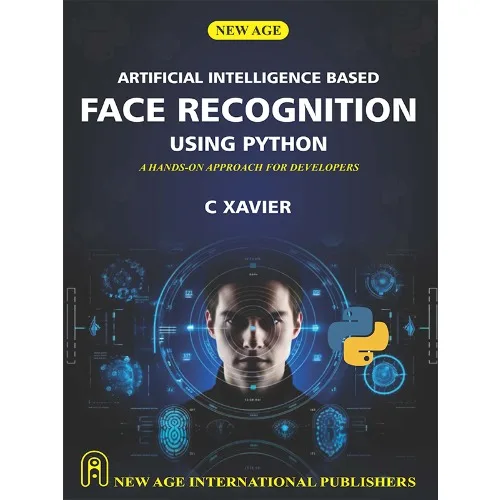
Artificial Intelligence based Face Recognition using Python: A hands-on approach for developers” is more than just a theoretical textbook. It is a practical blueprint for anyone looking to build real-world AI applications. In a world where face recognition has become a ubiquitous part of our daily lives, from unlocking smartphones to securing airports, this book demystifies the technology and empowers readers to create their own systems. It is meticulously designed to guide students and developers from foundational concepts to advanced, project-based applications, all within the accessible and powerful framework of the Python programming language.
The book’s core strength lies in its hands-on methodology. It rejects the traditional, abstract approach to AI and instead emphasizes active learning. Each chapter builds upon the last, taking the reader on a logical progression. You start with the basics of face identification and detection, learning how to use the Python Imaging Library (PIL) to find and mark human faces in a picture. This practical entry point ensures that even those with a limited background in AI can immediately see tangible results, fostering confidence and engagement. The focus then shifts to the core of face recognition: the concept of a “face signature” and the use of distance functions to compare them. The book provides engaging, relatable examples-such as proving family resemblance between siblings-that make complex ideas easy to grasp and fun to explore.
What makes this book unique is its seamless integration of powerful AI libraries with a practical, project-oriented mindset. It introduces the face recognition library, which leverages the power of Convolutional Neural Networks (CNNs) for highly accurate and efficient facial analysis. The real culmination of the book’s teachings is the development of a complete attendance management system. This project is a masterclass in application development, as it guides you through every design decision, from capturing images to comparing them against a database and recording timestamps. By the end, readers don’t just have a collection of code snippets; they have a fully functional, real-world application that can be adapted for a wide variety of domains.
The book’s value proposition is clear: it empowers independent developers. By providing a solid foundation in the algorithms and applications of face recognition, it equips readers to tackle their own projects. Whether for a student’s final-year curriculum or a professional’s new venture, the knowledge gained from this book is directly applicable. The final chapter on ethical and privacy issues is a crucial addition, ensuring that developers not only have the technical skills to build this technology but also a responsible understanding of its societal implications. In a field as dynamic as AI, this book stands as a definitive and practical guide, making face recognition accessible, understandable, and ultimately, a tool for creation.
Contents
- Introduction to Face Recognition
- Mathematical Techniques for Face Recognition
- Python Face Recognition Library
- Load and Display an Image File
- Face Detection: Locating Human Faces in a Picture
- Detecting Human Faces in a Picture and Mark with Rectangle
- Face Encodings
- Face Distance and Resemblance
- Face Recognition – The compare_faces Method
- Employee Attendance Management System A Project Work
- Ethical and Privacy Issues of Artificial Intelligence -Based Face Recognition Technology
- Case Studies on Ethical and Privacy Issues
- Bibliography
Dr. Xavier Chelladurai, a distinguished Professor in the Department of Computer Science and Engineering at the School of Engineering and Technology in CHRIST University, Bangalore, India, boasts an extensive career spanning over two decades within prominent international IT enterprises including Capgemini, Tech Mahindra, and HCL Technologies Ltd. His profound expertise encompasses education and research roles in esteemed institutions such as CHRIST University, Bangalore and St. Xavier’s College (Autonomous), Tirunelveli.
During his tenure as the Global Vice President and Head of Artificial Intelligence at Capgemini for over three years, he significantly contributed to the advancement of AI initiatives. Additionally, his leadership as the IT Service Delivery Head in London and Europe for leading IT firms has been instrumental in shaping operational excellence.
Dr. Chelladurai’s commitment to education and the proliferation of Computer Science and Artificial Intelligence knowledge is evident through the creation of over 500 educational videos, aimed at making these complex subjects accessible to students at large.
His scholarly pursuits and research interests predominantly revolve around Artificial Intelligence Technologies and Parallel Computer Algorithms. Notably, he holds authorship of more than 20 technical books in Computer Science, has published over 10 research papers, and has successfully mentored and guided seven Ph.D. scholars to completion.
Recognized for his contributions, Dr. Chelladurai holds the esteemed status of a Senior Member of IEEE and has been a Senior Life Member of the Computer Society of India. His dedication to academia, research, and the advancement of technology continues to leave a lasting impact within the field.
Dr. Xavier Chelladurai’s influence extends beyond academia and industry into governmental spheres. He served as a pivotal member of the Information Technology Task Force of the Government of Tamil Nadu for three years. This task force played a crucial role in advising and supporting the Chief Minister in formulating and implementing IT policies that were integral to the state’s technological advancement and growth. Dr. Chelladurai’s contributions to this body underscore his commitment to shaping not only academic and industrial landscapes but also governmental initiatives aimed at leveraging technology for societal progress.
No more offers for this product!
General Inquiries
There are no inquiries yet.









Reviews
There are no reviews yet.